
The anticipation in the cryptocurrency realm is palpable as the next Bitcoin halving looms on the horizon. This programmed occurrence slashes the number of Bitcoins awarded for successful block mining. For investors, grasping the intricacies and repercussions of the Bitcoin halving holds paramount importance in steering well-informed decisions and managing portfolios effectively in this dynamic cryptocurrency sphere.
Delving into the historical repercussions of prior halvings and dissecting present market trends enables investors to brace themselves for the impending halving and strategically position themselves in the ever-shifting cryptocurrency domain.
Decoding the Bitcoin Halving
Bitcoin is minted through the mining process, where miners vie with each other to crack an algorithmic puzzle. Upon solving the problem, a new block is appended to the blockchain, and the victorious miner receives a set amount of freshly minted Bitcoin. When Bitcoin first emerged in 2009, the reward rate stood at 50 Bitcoins for every block mined.
5 Stocks Our Experts Predict Could Double In the Next Year
By submitting your email, you'll also get a free pivot & flow membership. A free daily market overview. You can unsubscribe at any time.
The Bitcoin halving recurs approximately every four years or after mining 210,000 blocks; it is not bound by a specific time frame, and the periods between halvings can differ slightly due to fluctuations in mining difficulty and network hash rate, which gauges the total computing power employed to mine Bitcoin.
The upcoming halving is slated for around April 20, 2024. Following the three precedent halving events in 2012, 2016, and 2020, the current reward rate rests at 6.25 Bitcoins. The imminent halving will ratchet down the rate further to 3.125 Bitcoins per block.
The halving fundamentals are embedded in Bitcoin’s network. By curtailing block rewards, the halving decelerates the pace at which new Bitcoins are generated. This regulated supply aims to combat inflation, enabling Bitcoin to retain its value over time. As the halving milestones unfold, the influx of new coins will gradually dwindle until all 21 million Bitcoins are circulating.
Navigating the Impact on Bitcoin Miners
The Bitcoin halving reverberates significantly on the cryptocurrency’s mining activity and supply due to the dynamics of Bitcoin mining.
The mining process, synonymous with block time, typically lasts around 10 minutes. To sustain a consistent block time, the Bitcoin network adjusts mining difficulty based on hash rate—a metric measuring the computational power expended to mine Bitcoin and process transactions. An uptick in power signifies heightened competition among miners to craft new blocks and garner Bitcoin rewards, rendering the puzzle more challenging. When miner competition dwindles, the puzzle becomes simpler. This mechanism ensures a steady block creation rate, irrespective of the miners vying for it.
Historically, the hash rate has surged leading up to halving events, only to recede in the subsequent weeks as inefficient miners get sifted out.
“One of the ramifications is that miners operating outdated or energy-draining equipment are compelled to exit the industry. If they possess antiquated or energy-inefficient gear, they won’t sustain these costs when mining rewards plummet,” Eberle expounded.
The prevalent hash rates, characterized by Eberle as “record-high,” are propelled by major mining entities unveiling novel, swifter, and more efficient machinery while still leveraging outdated mechanisms that might phase out in a couple of months.
Investors reap the rewards of this efficiency since miners consistently vend Bitcoin to cover operational expenses and reap profits when production costs dip beneath the selling price.
Unpacking the Impact on Bitcoin Price
Bitcoin typically undergoes a surge in anticipation of the halving, albeit with only three halvings under its belt, definitively decoding price trends is challenging.
Historical Perspective
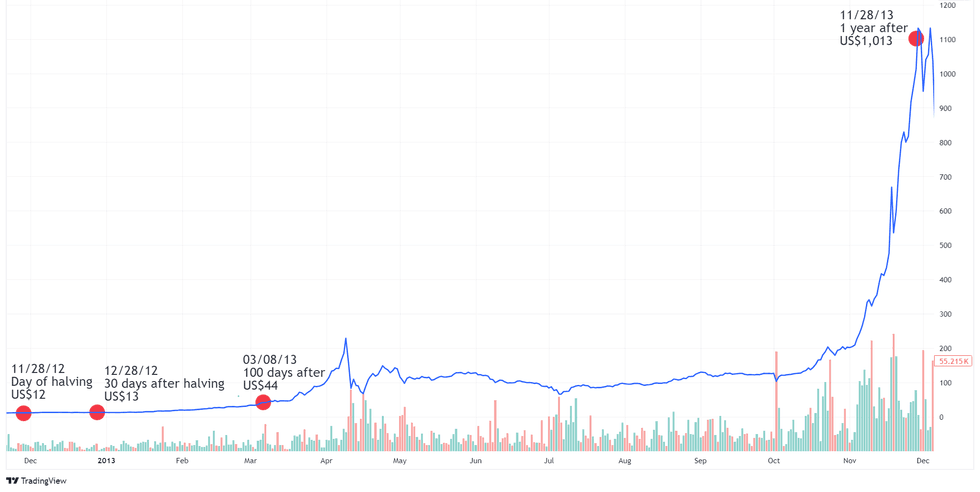
Chart via TradingView
Bitcoin USD price chart 11/21/2012 to 12/05/2013
The initial Bitcoin halving on November 28, 2012, marked the drop in mining rewards from 50 to 25 Bitcoins. While Bitcoin was still a niche offering back then, it had started garnering mainstream attention, partially due to economic uncertainties in Europe. Bitcoin’s value had ascended from roughly US$5.50.
The Rise and Fall and Rise of Bitcoin Prices
The Evolution of Bitcoin
In January of 2012, Bitcoin priced at approximately US$12 rose steadily to reach an intriguing US$1,013 after a year following a halving event. This surge marked the beginning of Bitcoin’s quest for recognition as a unique asset class. However, the honeymoon was short-lived, with a drop below US$300 in mid-2015.
The Bitcoin Halving Cycle
By July 9, 2016, during the second halving, Bitcoin had climbed back to US$648. Within a year, its value soared past US$2,500 in the wake of excitable anticipation and FOMO. This frenzy was further fueled by large financial institutions waking up to blockchain technology’s potential, propelling Bitcoin to an all-time high of US$19,783.21 in December 2017.
The Rollercoaster Ride of Bitcoin
Despite this upward trajectory, Bitcoin’s value saw a decline in early 2018 due to looming regulatory crackdowns, causing some investors to sell off their holdings. Fast forward to the latest halving on May 11, 2020, which saw Bitcoin at US$7,935.10. The event, though anticlimactic, set the stage for a monumental year for cryptocurrency.
The 2020 Bitcoin Boom
The outbreak of COVID-19 in 2020 triggered global economic uncertainty, leading experts to tout cryptocurrencies like Bitcoin as potential safe-haven assets. The decentralization boom coupled with large institutions like PayPal and Square embracing crypto as the new norm set Bitcoin on a path to greatness.
Insight into the Future of Bitcoin
Amidst the crypto renaissance in 2023, marked by legal wins and the promise of spot Bitcoin ETFs, Bitcoin saw a surge in price, breaking records. The recent approval of spot Bitcoin ETFs in January 2023 has reignited investor interest, with Bitcoin reaching new heights not seen since 2021, crossing the US$69,000 mark in March.
The Bitcoin Halving Buzz: Analyzing Investment Potential
Interpreting Market Trends Ahead of the Bitcoin Halving
As the cryptocurrency realm braces for the forthcoming Bitcoin halving event, with speculations swirling in the financial stratosphere, analysts are deciphering the riddles of supply and demand dynamics. The looming halving often triggers intricate responses in a harmonious ballet of market forces.
Discussing the influence of Exchange-Traded Funds (ETFs) on the Bitcoin market, analysts are pointing to a unique twist in this iteration. The prevailing narrative suggests that ETFs are absorbing excess supply usually generated by miners upgrading their equipment, potentially paving the way for substantial gains post-halving.
Navigating Bitcoin Investment Strategies Amid Halving Speculations
Renowned analyst Peter Brandt, amidst the Bitcoin fever, prophesizes a meteoric rise in Bitcoin’s price, setting a target of US$200,000 by September. A staggering 66 percent leap from his prior assessment, Brandt’s prediction sets the stage for an exhilarating journey in the cryptocurrency sphere.
Embracing the optimistic wave, enthusiasts foresee the dawn of new all-time highs, heralding a potential surge driven by retail investor participation. The allure of ETF accessibility is anticipated to ignite a frenzy of retail “fear of missing out” (FOMO), catapulting prices to dizzying heights before an inevitable correction.
Crafting a Resilient Investment Portfolio with Bitcoin
For astute investors contemplating Bitcoin’s role in their portfolio, the mantra of diversification resonates profoundly. Expounding on the potential benefits, experts suggest integrating a modest 3 to 5 percent Bitcoin allocation into a conventional 60/40 equity-bond portfolio.
The rationale behind this strategy lies in Bitcoin’s uncorrelated, volatile nature, adding a dash of spirited fluctuations that could enhance overall portfolio performance. By deftly rebalancing quarterly, investors can harness Bitcoin’s rollercoaster ride to potentially reduce volatility and bolster returns.