
Get the latest insights on Bitcoin, Ether and altcoins, along with a round-up of key cryptocurrencymarket news
Here’s a quick recap of the crypto landscape for Monday (July 20) as of 10:00 p.m. UTC.
Bitcoin price update
Bitcoin (BTC) was priced at US$65,102.57, up by 1.1 percent over the past 24 hours.
5 Stocks Our Experts Predict Could Double In the Next Year
By submitting your email, you'll also get a free pivot & flow membership. A free daily market overview. You can unsubscribe at any time.
Crypto prices are higher after a shaky performance ahead of North America’s market open following hostilities in the Middle East over the weekend. Simon-Peter Massabni, head of business development at XS.com, said that while recent Bitcoin exchange-traded fund (ETF) inflows have stabilized market sentiment and eased selling pressure, the recovery lacks the broad institutional strength required to signal a definitive new uptrend.
“The fact that inflows into the iShares Bitcoin Trust ETF (NASDAQ:IBIT) exceeded the total net inflow for the entire market indicates that demand remains heavily concentrated in a single large fund rather than being broadly distributed,” he said in commentary shared with the Investing News Network (INN).
“Therefore, four consecutive sessions of inflows should be interpreted as a sign that selling pressure is easing, rather than clear evidence that institutional investors have returned on a broad scale.”
Lacie Zhang, research analyst at Bitget Wallet, noted:
“ETF inflows are supportive, but they are not large enough to overpower macro selling and deleveraging. Recent spot BTC ETF inflows show institutional demand has returned, but July is still repairing the damage from prior outflows, including heavy redemptions in May and June.”
“In this environment, ETF demand can absorb supply and prevent a deeper breakdown, but it does not automatically create upside momentum if hedge funds, miners, treasury vehicles or leveraged traders are reducing exposure at the same time.
“The key point is that ETFs are a stabilizer, not a full catalyst when macro volatility is rising.”
Meanwhile, Bitfire Research Institute argues that markets are misinterpreting recent inflation data as a broad disinflationary trend, failing to account for the systemic, persistent inflationary pressure caused by recurring supply chain disruptions in the Strait of Hormuz and ongoing semiconductor sector instability.
Analysts at the firm noted that the market’s true test will arrive when the supply chain friction from the strait begins to manifest in the data, a process that could take a full quarter.
In the near term, Massabni identified the US$65,000 to US$65,500 range as the key resistance area.
“If BTC breaks above and holds this zone, the recovery could extend toward US$67,000 to US$68,000. Conversely, if prices continue to face rejection and ETF inflows weaken again, Bitcoin could return to test the area around US$62,000, followed by US$60,000,” he explained to INN.
Bitcoin price chart
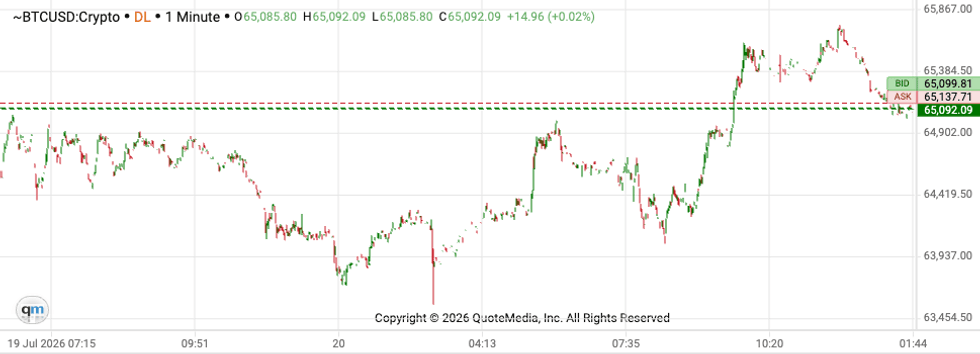
Chart via the Investing News Network.
Bitcoin price performance, July 20, 2026.
Ether and altcoin price update
- Ether (ETH) was priced at US$1,898.52, trading 1.7 percent higher over the last 24 hours.
- XRP (XRP) was priced at US$1.12, trading 1.8 percent higher over the past 24 hours.
- Solana (SOL) was trading at US$7759, trading 2.3 percent higher over the past 24 hours.
Today’s crypto news to know
Read on for a round-up of the biggest cryptomarket news
- GENIUS Act turns one
- Bitcoin miners rally on infrastructure deals
- Grayscale to turn staking rewards into quarterly cash payouts
GENIUS Act turns one
The GENIUS Act celebrated its first anniversary on Saturday (July 18).
The act served as a critical signal, moving stablecoins into the mainstream and encouraging institutions to make long-term investments. Market adoption has grown, with increased transaction volumes and institutional participation.
Commentary provided to INN from financial and industry leaders reflects on its impact on stablecoin adoption and the US financial system. Experts emphasize that while the GENIUS Act provided issuance clarity, the proposed CLARITY Act is the necessary next piece of the puzzle to complete the architectural framework for institutional onchain finance, specifically regarding how stablecoins move through the banking system.
“If CLARITY passes, the biggest unlock will be speed,” said Trace Finance’s Diogo Cassinelli. “A definitive framework means banks and payment providers can say yes faster because the compliance question has already been answered at the federal level, rather than each institution making its own risk call. CLARITY gives a definitive path for large institutions to move money with stablecoins, while also giving startups a clear map to build for these institutions.”
Additionally, regulatory execution has lagged, forcing businesses to operate under legacy disclosures, complicating banking relationships, slowing down cross-border payment processes and adding costs.
The next six months are considered a crucial test for the industry. While the foundational framework is established, the industry is waiting on finalized rules and clear interpretations to resolve lingering issues.
Bitcoin miners rally on infrastructure deals
Bitcoin-mining stocks surged on Monday after Hut 8 (TSX:HUT,NASDAQ:HUT) and IREN (NASDAQ: IREN) both announced major artificial intelligence (AI) infrastructure deals, boosting optimism about miners expanding into AI and high-performance computing. In early trading, IREN, Cipher Digital (NASDAQ:CIFR), CleanSpark (NASDAQ:CLSK), Hut 8 and MARA Holdings (NASDAQ:MARA) each jumped at least 11 percent.
The rally follows Hut 8’s announcement of a 15 year, US$9.8 billion AI data center lease.
At the same time, IREN disclosed US$2.8 billion in cloud services contracts. IREN now projects its AI cloud annual recurring revenue will surpass US$4 billion by the end of 2026.
Both companies have shifted from Bitcoin mining toward AI infrastructure as mining economics weakened.
Grayscale to turn staking rewards into quarterly cash payouts
According to Form 8-K filings submitted to the US Securities and Exchange Commission, Grayscale plans to modify the trust agreements for the Grayscale Solana Trust ETF (ARCA:GSOL) and the Grayscale Ethereum Trust ETF (ARCA:ETHE) around August 7. Under these new amendments, both trusts will be required to convert their staking rewards into cash at least quarterly and distribute the net proceeds directly to shareholders.
This would give holders a more traditional income-style structure, similar to receiving a cash distribution instead of just accumulating on-chain yield. It also formalizes a model Grayscale had already tested.
Don’t forget to follow us @INN_Technology for real-time news updates!
Securities Disclosure: I, Meagen Seatter, hold no direct investment interest in any company mentioned in this article.
Editorial Disclosure: The Investing News Network does not guarantee the accuracy or thoroughness of the information reported in the interviews it conducts. The opinions expressed in these interviews do not reflect the opinions of the Investing News Network and do not constitute investment advice. All readers are encouraged to perform their own due diligence.