
Among the more remarkable turnarounds that perhaps doesn’t quite get as much attention is Anheuser-Busch Inbev SA‘s BUD efforts in righting its ship. About two years ago, the beverage maker suffered blowback when its Bud Light brand inked a promotional campaign with Dylan Mulvaney, an influencer who documented her gender transition.
Although the marketing managers likely had the intention of promoting social equity, many conservatives lashed out at what they termed “woke culture,” with the uproar leading to red ink for BUD stock.
Fundamentally, Anheuser-Busch was in a tricky position. On one hand, the company could score points with more progressive consumers. At the same time, it risked alienating conservative consumers by wading into political waters. Not only that, Donald Trump and his followers — often called the Silent Majority — have blasted institutions and ideologies perceived as woke.
5 Stocks Our Experts Predict Could Double In the Next Year
By submitting your email, you'll also get a free pivot & flow membership. A free daily market overview. You can unsubscribe at any time.
See Also: US Services Sector Unexpectedly Expands In February Despite Slowing Job Growth
To reiterate the point, President Trump’s speech to Congress heavily criticized leftist politics, declaring that the nation “will be ‘woke’ no longer.” On the surface level, this line of reasoning represents a headwind for BUD stock. However, Trump’s economic priorities could ironically make Anheuser-Busch great again.
In fairness, Trump urged conservatives last year to give the beverage maker a second chance. More importantly, the administration’s tariffs — which Trump himself doubled down on during the address to Congress — may provide a competitive edge for Anheuser-Busch.
BUD Stock May Benefit from Multiple Catalysts
One of the cynical reasons why Anheuser-Busch could keep inching forward is that the tariffs may impose disproportionate hardships on the competition. A clear example of this is Constellation Brands Inc. STZ, which owns the U.S. distribution rights of the Corona beer brand, a consequence of an antitrust settlement.
At the time, Anheuser-Busch giving up the U.S. distribution rights for a popular Mexican beer was a significant hit. Today, under the threat of an ugly trade war, not having to deal with potentially sharp price hikes for Corona is a blessing.
Another catalyst for BUD stock stems from the core business itself. Anheuser-Busch specializes in low-cost beer and that’s a powerfully relevant offering amid an environment of brewing economic challenges. Now, it’s true that the company’s Bud Light brand got knocked off the top of the U.S. beer sales ranking. However, the current top seller — the Constellation-distributed Modelo Especial — faces tariff risks.
Even statistical trends seem to favor a position in BUD stock. Ordinarily, using data since January 2019, the security carries a neutral to slightly negative bias. That’s because a position held for eight weeks carries a baseline probability of upside success of 49.52% — essentially a coin toss.
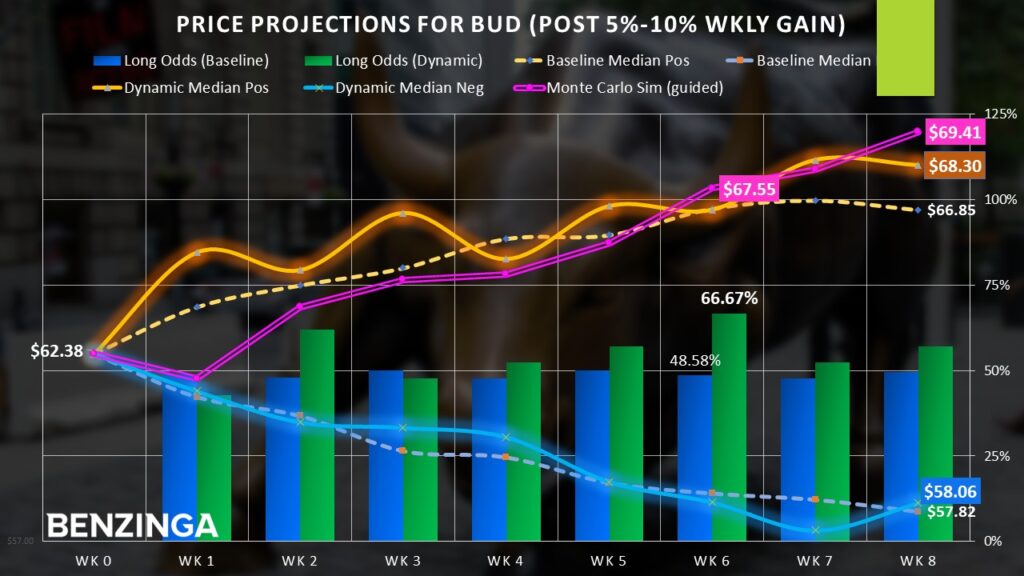
However, under the dynamic conditions of sizable momentum (defined as a weekly return between 5% to 10%), the subsequent eight weeks commands long odds of 57.14%. In the past five sessions, BUD is up around 5.4%.
Finally, BUD stock is on a streak of seven consecutive up weeks. Over the past six years, such streaks have only materialized three times. Investors shouldn’t read too much into this but so far, this streak has yet to see a trend reversal in the eighth week.
Setting Up an Options Strategy for Anheuser-Busch
From a psychological and technical perspective, the bulls will likely push for the $70 level. This threshold represents prior resistance. In addition, it’s also close to Wall Street analysts’ consensus price target of $70.60. However, the time necessary for BUD stock to reach this level represents a significant component of the speculation.
Running a guided Monte Carlo simulation based on market realistic dynamics, it’s possible that BUD could reach $67.54 by the options chain expiring April 17. For extremely aggressive investors, one could consider the 62.50/67.50 bull call spread.
This transaction involves buying the $62.50 call (at a $205 ask) and simultaneously selling the $67.50 call (at a $40 bid). The sale of the short call will partially offset the debit of the long call, leading to a net debit paid of $165 at time of writing. Subtracting this figure from the difference in the strike prices (multiplied by 100 shares) comes out to a maximum reward of $335 should BUD reach or exceed the short strike price. This would translate to a payout of 203%.
Now Read:
Image: Shutterstock
Market News and Data brought to you by Benzinga APIs