
How to recognize the companies that tech giants may decide they cannot afford to lose
Listen to the audio version of this article (generated by AI).
5 Stocks Our Experts Predict Could Double In the Next Year
By submitting your email, you'll also get a free pivot & flow membership. A free daily market overview. You can unsubscribe at any time.
In May 2023, Spark Capital made the biggest investment in its history.
The venture-capital firm wrote an initial $75 million check to help fund Anthropic, then a little-known artificial intelligence startup trying to compete with OpenAI. Anthropic had no stock symbol, and it generated very little revenue. There was no Wall Street research report telling investors what it was worth.
Three years later, Spark’s stake is estimated to be worth $7 billion on paper.
Spark Capital only needed one Anthropic. History suggests investors often don’t need many, either.
I keep coming back to that story because I think it marks the beginning of the current AI investment cycle. Investors like Spark provided the capital that helped companies like Anthropic grow into some of the most valuable businesses in the world.
But that cycle is already changing.
AI’s Builders Are Becoming Buyers
The companies that were startups just a few years ago are fast becoming giants themselves: Anthropic, OpenAI, and others. Along with Microsoft Corp. (MSFT), Alphabet Inc. (GOOG), Amazon.com Inc. (AMZN), Meta Platforms Inc. (META), and Nvidia Corp. (NVDA), they’re raising – and spending – enormous amounts of money, and racing to build what they believe will become the next great computing platform.
Sooner or later, though, they’ll find they can’t invent everything themselves. No company — not even the AI labs valued near $1 trillion — can hire every brilliant engineer or invent every breakthrough first.
Long story short, I think we’re entering the next phase of the AI boom.
The first phase rewarded investors who recognized that AI infrastructure – chips, memory, networking, power, and data centers – would become essential. I still believe many of those companies have room to run.
But the next phase could look very different.
Instead of asking, “Which companies will build AI?” investors may soon need to ask, “Which companies will AI’s biggest players decide they have to own?”
If I’m right, answering that one question could make the difference between simply participating in the AI Revolution… and getting there before the rest of Wall Street catches on.
That’s what I want to show you today.
First, I’ll explain why I think the AI arms race is entering a new phase.
Then I’ll show you how Silicon Valley’s biggest companies tip their hands long before they announce their next blockbuster acquisition.
Finally, I’ll explain the framework I’ve started using to identify the kinds of companies I believe could become tomorrow’s biggest winners, whether they eventually go public or get bought first.
Let’s start by following the money…
Follow the $700 Billion AI Arms Race
One of the first rules I learned as an investor is that money leaves clues. When hundreds of billions of dollars begin flowing in the same direction, I pay attention.
Right now, the money isn’t just flowing into Nvidia.
It’s flowing into the entire AI ecosystem.
Follow the money.
Amazon alone expects to pour roughly $200 billion into capital projects this year. Microsoft and Alphabet are each planning about $190 billion. Meta could spend another $135 billion.
That’s roughly $700 billion in a single year, or about $2 billion every single day.
That’s an arms race.
Meanwhile, Anthropic’s latest funding valued the company at around $965 billion. And OpenAI is said to be worth roughly $852 billion.
But even when companies have that kind of money, they can’t invent everything themselves. Call it Silicon Valley’s dirty little secret: It’s often faster to buy innovation than build it yourself.
AI Giants Will Buy What They Cannot Build Fast Enough
Think about what these companies are trying to accomplish.
The companies leading AI genuinely believe they’re building the next computing platform. When the stakes get that high, companies stop asking, “Can we build this?” and start asking, “Who already has?”
We’ve seen this movie before.
In 2012, Facebook paid $1 billion for Instagram. At the time, it looked ridiculous.
Instagram had just 13 employees. It wasn’t making money. Most people thought Mark Zuckerberg had wildly overpaid for a photo-sharing app that let people put vintage-looking filters on pictures of their lunch.
Turns out, Zuckerberg got the bargain of the century. Instagram has since become one of Meta’s most valuable businesses. Last year, Meta estimated Instagram’s brand value at over $70 billion, and said it generates nearly $67 billion in annual revenue.
But that’s not what I find most interesting.
The biggest winners weren’t the people who bought Meta stock after the Instagram deal was announced. They were the people who already owned a piece of Instagram before Zuckerberg came calling.
And this pattern continued throughout the last few tech booms:
Google bought Android before smartphones became ubiquitous and picked up YouTube before online video dominated media.
Facebook bought Instagram and WhatsApp before those businesses reached their full potential.
Microsoft acquired GitHub as software development became increasingly collaborative and cloud-based.
Notice the pattern. None of these companies were acquired because the buyers were running out of money. They were acquired because the buyers were running out of time.
I think AI is setting up a similar dynamic, only on a much bigger scale.
Why the Best AI Acquisition Targets May Never Reach the Stock Market
For decades, most investors assumed the stock market was where great companies began.
Increasingly, it’s becoming where they finish their first chapter.
Think about Space Exploration Technologies Corp. (SPCX).
Millions of investors finally had the opportunity to buy shares after the IPO. But by then, SpaceX had already spent years building rockets, launching satellites, signing government contracts, and creating enormous value.
And within weeks of the IPO, its shares slid far below its high of $202.50 – as well as the original $135 offer price.
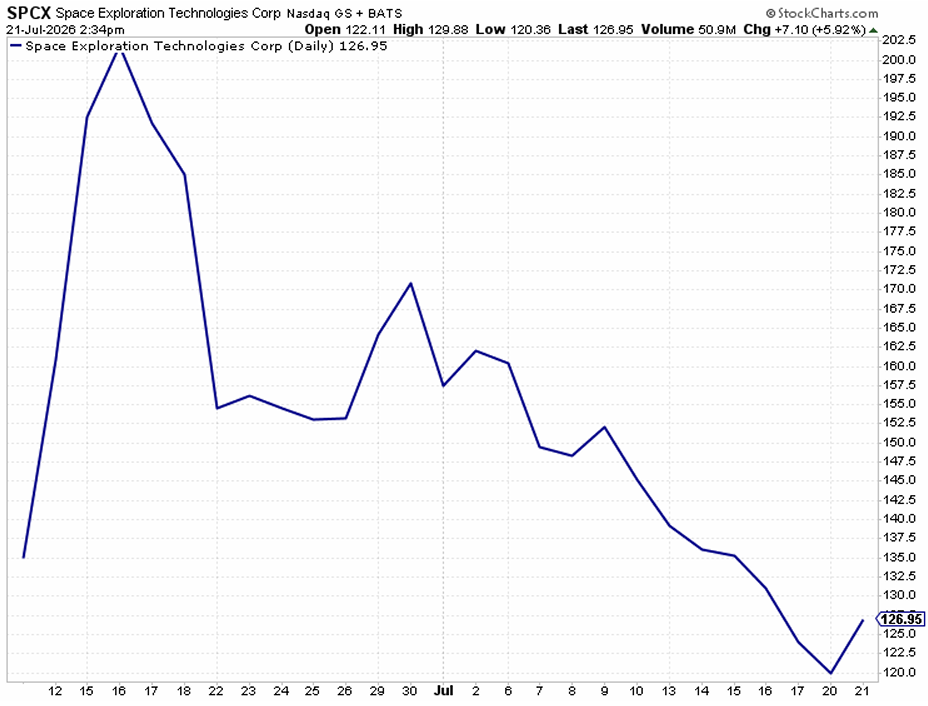
If you got in on Day One, you were part of the largest IPO in history. But the momentous occasion didn’t prevent you from getting caught in a painful drawdown.
Investors who entered years earlier were playing a different game entirely. They bought at private valuations far below the one public investors received on IPO day. A modest change in the public stock price therefore means something very different to those two groups.
Two people can believe equally in the same company and still walk away with radically different results.
That’s why I’ve recently started asking: Which companies will become so important that an AI giant decides it cannot afford to compete against them?
Some of those companies will become the next generation of AI leaders. Others may receive buyout offers long before they ever ring the opening bell on Wall Street.
Either path can create enormous value.
The challenge is recognizing those businesses early.
The Bottom Line: Find the Companies AI Giants Cannot Ignore
Over the past year, I’ve built an entirely different framework for finding those opportunities.
It isn’t based on chasing whatever stock is trending on social media. It isn’t based on guessing tomorrow’s headlines. Instead, it’s based on following the money.
I study where Silicon Valley is investing, what capabilities the largest AI companies still lack, and which smaller businesses are solving problems the giants may eventually decide they need to own.
It’s a different research process and a whole different way of looking at the AI boom.
And honestly, I think it’s one of the most exciting parts of this entire cycle.
History tells us that during technological revolutions, the headlines almost always focus on the giants.
But the biggest fortunes are often created one or two layers beneath them.
Back in 2023, Spark Capital saw something in Anthropic that most of the world could not. That one decision may become one of the defining investments of the AI era.
I believe the next chapter of AI could produce similar opportunities –because every technological revolution creates a new generation of companies solving problems the giants can’t solve alone.
My goal isn’t to find another Anthropic. It’s to find the companies Anthropic and the rest decide they can’t afford to ignore.
That’s what I’m going to show you on Thursday, July 30, at 1 p.m. Eastern. On that day, I’ll walk you through this framework during a free online event I’m calling The 2026 AI Megadeal Event. (You can reserve your spot here.)
I’m going over a few things during that event.
- Why I believe the AI investment cycle is entering an entirely new phase.
- The framework I use to identify companies that could become tomorrow’s AI leaders – or tomorrow’s acquisition targets.
- One specific opportunity I believe illustrates exactly how this next phase could unfold.
The first phase of the AI boom rewarded the companies building the future. I think the second phase could reward the companies those builders decide they need to own.
And I’m going to show you how to look for them. The event is free. All you need to do is reserve your seat here in order to receive an invitation (plus my bonus report: “The AI Collectors’ Portfolio: 7 Stocks to Buy for the Biggest Tech Spending Boom of All-Time.”)
I hope you’ll join me.