
NATO, the North Atlantic Treaty Organization, celebrated its 75th anniversary recently amidst a challenging backdrop. As Prime Minister Donald Tusk cautioned about Europe entering a “pre-war era,” the geopolitical landscape is fraught with uncertainties, demanding heightened defense readiness.
The current era of warfare is evolving, witnessing a surge in conflicts involving non-state actors like Hamas and the Houthis, along with the rising dominance of China and the swift integration of artificial intelligence (AI) in military strategies. The ongoing Ukrainian crisis, prompted by Russia’s invasion, has further emphasized the imperative for NATO to bolster its support for Kyiv in the face of escalating tensions.
While statistics exhibit a historical decline in armed conflicts and war-related fatalities across the globe since NATO’s establishment in 1949, recent years have witnessed a concerning uptick in hostilities. Data from Our World in Data illustrates that the total number of armed conflicts globally in 2022 was the highest recorded since 1989, necessitating a robust defense response.
5 Stocks Our Experts Predict Could Double In the Next Year
By submitting your email, you'll also get a free pivot & flow membership. A free daily market overview. You can unsubscribe at any time.
The surge in violence has triggered a significant escalation in defense expenditures among NATO member countries. An anticipated 18 nations within the alliance are set to allocate at least 2% of their GDP to defense this year, a dramatic increase from merely three nations in 2014, highlighting the growing commitment to security.
Rising Military Imports Reflecting Escalating Global Tensions
Modern warfare transcends traditional state-to-state conflicts, with non-state entities increasingly participating in armed confrontations. The proliferation of AI and machine learning, harnessed in autonomous weaponry such as Ukraine’s Saker Scout drone, is fueling concerns regarding their potential deployment in cyber, physical, and biological attacks.
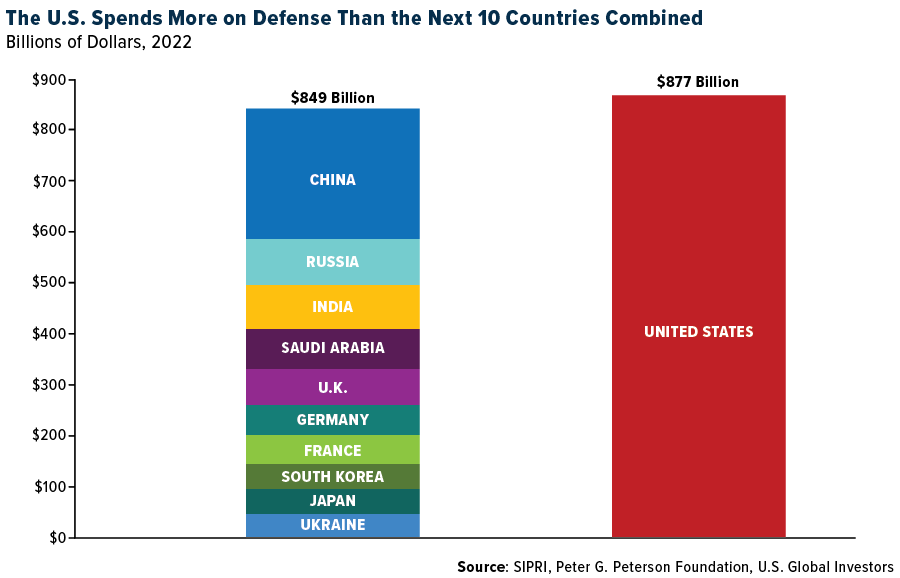
According to SIPRI, European nations have nearly doubled their major arms imports between 2019 and 2023, signaling a strategic shift in response to mounting tensions. However, this trend is not confined to Europe alone. The U.S., already an unparalleled big spender on defense, is closely monitoring China’s aggressive modernization efforts, with a particular focus on developing cutting-edge technologies including hypersonic missiles and AI.
Varied Investment Prospects in the Defense Sector
For discerning investors, the surge in defense expenditure unveils a lucrative opportunity. In the U.S., a substantial portion of the Department of Defense’s budget flows to military contractors, amounting to around $400 billion in 2021. Among the myriad of contractors nationwide, the “Big 5” defense firms—Lockheed Martin, Boeing, RTX, General Dynamics, and Northrop Grumman—reaped close to 30% of all DoD contract funds.
Furthermore, the U.S. defense industry’s AI supply chain exhibits diversity, with 300 contracts dispersed among 249 distinct vendors in recent data. Of these, only 36 suppliers secured multiple contracts, with eight entities garnering three or more contracts, including industry giants like Lockheed Martin and Northrop Grumman, as outlined by the Center for Security and Emerging Technology (CSET). This concentration of AI contracts among select players positions them advantageously to capitalize on the escalating demand for innovative defense solutions.
Optimistic Outlook for Defense Stocks
While investing in defense equities harbors risks, influenced by governmental policies, geopolitical developments, and public sentiments, the sector’s long-term prospects appear favorable. With nations globally ramping up defense spending, companies spearheading defense technology and ingenuity stand to gain. The U.S. defense industry, endowed with a robust footing in the arms trade and cutting-edge AI capabilities, holds a particularly advantageous position.
Critics may cast shadows over NATO’s efficacy, yet its pivotal role in preserving stability remains paramount. For perceptive investors, this juncture presents a distinctive opening to leverage the escalating demand for advanced defense technologies, notably from dominant U.S. contractors.
***
Past performance is not indicative of future results. The opinions expressed and data shared are subject to fluctuations without prior notification. Certain opinions may not be suitable for all investors.