
Ever since the Biden-Harris Administration took the reins from the previous White House administration, the number of publicly available electric vehicle (EV) chargers in the US has soared. The US Department of Energy declared that approximately 1000 public EV chargers are being added on a weekly basis since the new administration took office. However, an intriguing question arises – who lays claim to these chargers?
The Growth of Public EV Chargers
The US Department of Energy disclosed in a statement that there are now more than 192,000 publicly accessible charging ports sprinkled across rural, suburban, urban, and tribal regions throughout the nation.
New Investments and Grants
On the same token, the Biden-Harris Administration recently revealed the allocation of $521 million in grants aimed at erecting over 9,200 EV charging ports across 29 states, two Federally Recognized Tribes, and the District of Columbia.
5 Stocks Our Experts Predict Could Double In the Next Year
By submitting your email, you'll also get a free pivot & flow membership. A free daily market overview. You can unsubscribe at any time.
A Critique of Progress
However, despite setting aside $5 billion to construct EV charging infrastructure via the National Electric Vehicle Infrastructure (NEVI) Formula Program in 2021, the Biden administration has faced criticism for the sluggish pace of EV charging station deployment, with Former President Donald Trump being among the vocal critics.
The Ownership Landscape
Delving into the ownership details of existing EV chargers as per the DOE’s data center, there are a staggering 196,063 public EV charging ports spread out among 72,573 station locations nationwide.
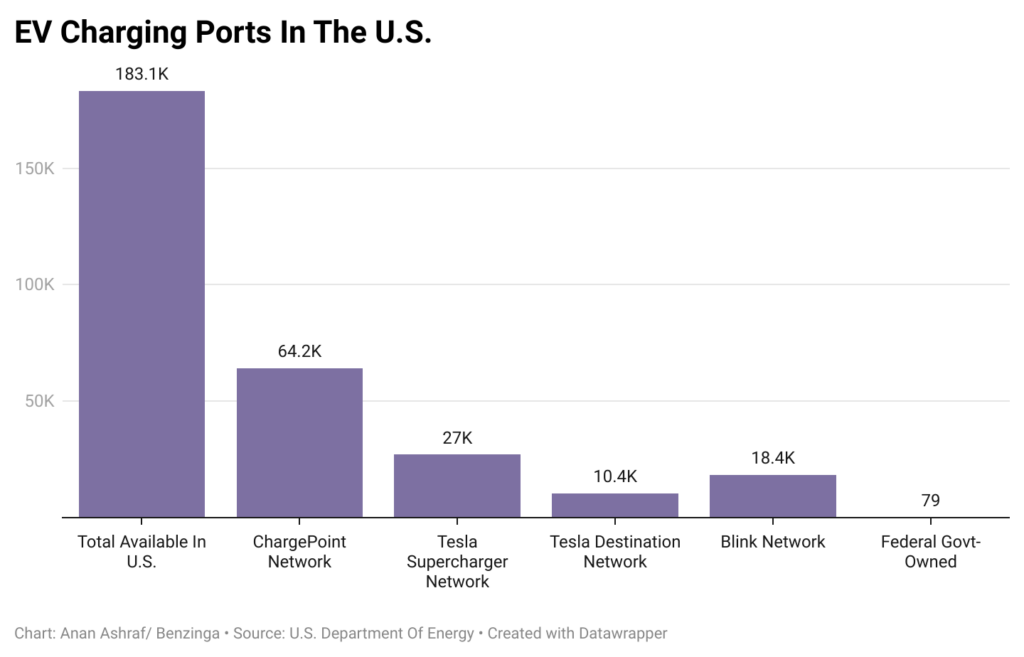
While not all of these charging ports are presently operational, with 1,907 ports either under construction or permitted and over 11,000 ports temporarily offline, the majority of the nearly 183,000 functional charging ports are privately owned.
Among these private owners, there are nearly 63,000 charging ports under private ownership, starkly contrasting the mere 79 ports owned by the federal government. State governments claim about 1000 ports, while local or municipal governments count about 4000 ports under their ownership.
Tesla Inc’s supercharger network boasts ownership of around 27,000 ports, with an additional 10,000 ports attributed to the EV giant’s destination charging network. Blink Charging comes in with 18,425 ports, and ChargePoint leads the pack with approximately 64,000 ports.
Despite the buzz surrounding the National Electric Vehicle Infrastructure (NEVI) Formula Program, a stark reality emerges – only 68 charging ports have been installed at 19 station locations under this initiative, as the data center indicates.
For further insights into the future of mobility, feel free to dive into Benzinga’s dedicated coverage area.